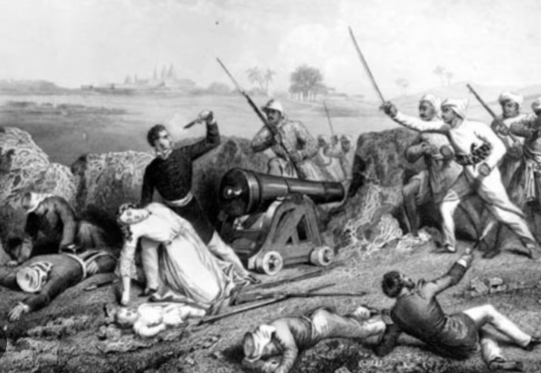
The Revolution of 1857 is forever immortalized in the pages of history. Historians have varying opinions regarding the struggle of the 1857 Revolution. Some scholars believe that this four-month uprising was a peasant revolt, while others consider it a military rebellion.
Different scholars have different opinions. V.D. Savarkar’s book, The Indian War of Independence, published in 1909, also described as a mutiny. The rebellion led by Mangal Pandey at the Barrackpore Cantonment near Kolkata is considered a significant event, marking the first war of independence.
The East India Company’s service played a crucial role in the establishment of British colonial rule in India. During Warren Hastings’s tenure as Governor General, the East India Company steadily expanded its territory and service by gradually annexing states. Over 80% of the British service personnel were of Indian origin. Unlike European soldiers, they were given the status of sepoys. We had already witnessed the devotion of these soldiers to the East India Company in the Battles of Plassey and Buxar.
An important immediate cause of this rebellion was the Mutiny of 1857. The immediate cause was the presence of pig and cow fat on the cartridge cases of the 1853 rifle. Muslim soldiers would spit out pig fat, and Hindu soldiers would spit out cow fat, as it was coated on the cartridges, and our teeth are the strongest bone, making it easier to remove. This hurt the sentiments of both Hindus and Muslims. This rifle was part of the 1853 rifle arsenal.
The Revolution of 1857:
This revolution was not a sudden incident; the 1857 revolution was the result of many factors, including political, economic, social, religious, administrative, and military factors.
Let’s explore these causes in detail.
Causes of the 1857 Revolution:
The 1857 Revolution had political, social, and economic causes that left their mark on the golden pages of history.
Political Causes:
Dalhousie’s Imperialist Policy:
Lord Dalhousie used numerous and other methods to expand his empire in India. There was widespread discontent among the Nawabs of the princely states against the Company. He adopted the Doctrine of Lapse. This doctrine meant that princely states under the Company’s control would be required to obtain the British government’s approval of their successors. If a princely state lacked a child, it would lose the right to rule. It would become subject to the British Empire. If such princely states failed to do so, the British government would not recognize the successor as the legitimate ruler of their states. Based on this policy, Dalhousie banned the adoption of children by princely states.
On this basis, he annexed the princely states of Jaitpur, Sambalpur, Udaipur, Jhansi, Nagpur, and other princely states into the British Empire. He accused the Nawab of Awadh of misrule and annexed Awadh to the British Empire in 1856. Dalhousie’s imperialist policy created a sense of disdain and complacency towards the British government among Indian settlers. Furthermore, loyalists began to doubt their own existence.
Indeed, Dalhousie’s policy had a profound impact on Indians. Under these circumstances, rebellion against the British Empire became a human necessity.
He annexed Awadh to the British Empire in 1856, accusing the Nawab of Awadh of misrule and annexing it. Furthermore, loyalists began to doubt their own existence. Indeed, Dalhousie’s policy had a profound impact on Indians.
Under these circumstances, rebellion against the British Empire emerged as a human necessity.
Contemporary Situation:
Indians used to say that British soldiers never lose; they are defeated. But the British defeats in the Crimean and Afghan wars shattered this myth.
At the same time, rumors spread that Russia was planning to invade India to avenge its Crimean defeat, and that India would support it.
This fueled a sense of rebellion among Indians. They thought that while the British were busy fighting Russia, they would revolt and drive the British out of India.
Insult to Emperor Bahadur Shah:
Mughal Emperor Bahadur Shah was a kind-hearted man. The native kings and the Indian people also considered him their king and held him in high esteem. The British treated Mughal Emperor Bahadur Shah with disdain and mistreatment. The British now made it a crime to pay tribute to the Mughal Emperor or to show respect to him. His name was removed from the currency.
Injustice done by the British to Nana Saheb:-
Lord Dalhousie severely mistreated Nana Saheb, the adopted son of Bajirao II. Nana Saheb’s pension of ₹800,000 was stopped. After this, Nana Saheb resolved to drive the British out of India and led the Revolt of 1857.
Economic Reasons:-
The 1857 Revolution was marked by significant causes, of which the economic one was crucial.
Destruction of Trade:-
The British plundered India extensively, amassing wealth through plunder.
and continued to send it to England.
The British began sending raw materials from India to England and bringing finished goods back to India.
After this, India began to decline day by day, its economy eroding. Consequently, Indian industries began to collapse completely.
Thus, the British established their control over Indian trade, and this proved to be the downfall of the Indian economy.
The economic exploitation of Indians was the biggest economic factor.
Complete exploitation of farmers:
The British imposed numerous taxes on farmers, the most prominent of which were the Permanent Settlement, Ryotwari, Mahalwari, etc.
However, farmers were exploited in all these practices. Exorbitant rents were being collected from them. This worsened the plight of farmers.
The land of farmers who did not pay their taxes on time was auctioned.
Famine:
During the British period, famines occurred frequently in India, worsening the situation for the peasants.
The reward estates were confiscated.
The British gradually began withdrawing the reward estates granted to the elite, leading to the complete demise of many of the elite. They were now left without work. The renowned Bombay Bounty Commission confiscated 20,000 estates in 1852.
This led to growing discontent among the elite, which was a major factor in the rebellion.
Unemployment:
This was a time when people were left without work. Due to the British policy of economic exploitation, India’s domestic industries began to collapse.
Unemployment spread widely across the country, leaving people without work.
Social Causes:
The social events of 1857 are as follows.
British Interference in Indian Social Life:
The British’s complete interference in Indian social life led to resentment of the traditional and conservative Indian population.
Lord William Bentinck outlawed the practice of Sati, and Lord Canning authorized the practice of widow remarriage. This led to a deep unease among the public. Furthermore, in 1856, a law was passed regarding ancestral property, changing the inheritance rules for Hindus. This ensured that anyone who converted to Christianity would retain their ancestral property. Conservative Indians disliked this kind of British interference in their social life and decided to rebel, a major factor in the 1857 Revolution.
Propagation of Christianity:
The British made great efforts to promote their culture and began to spread it in India. They promoted European medical science, which was contrary to Indian medical science. The Indian people considered the telegraph and railways to be against their civilization. The British greatly encouraged Christianity. Schools, hospitals, and offices became centers for the propagation of Christianity. Indians now believed that the British were destroying their culture.
Therefore, they began to harbor deep resentment towards them, which further fueled the revolution.
The Spread of English Education:
English education destroyed the fundamental characteristics of Indian society. Traditional characteristics of Indian society were characterized by gratitude, observance, and mutual cooperation. However, British education completely destroyed them. The advancing civilization began to bring revolutionary changes to the lifestyle, food habits, manners, thoughts, etiquette, and behavior of Indians.
The originality of Indian social life began to completely disappear. The elite were deeply angered by the British taking away their awareness.
This fear arose among Indians due to the British’s interference in their social lives.
The British were promoting Western culture. The conservative Indian public began to oppose scientific experiments like the railway and telegraph, arguing that these would completely destroy their civilization.
Policy of Discrimination Against Indians:
The British practiced a policy of discrimination against Indians. They considered Indians inferior and hated them. They began adopting a policy of complete discrimination against Indians. Indians were not allowed to travel in first-class train compartments because the British traveled there. They were not allowed to enter British-run clubs and hotels; their entry was completely blocked.
Religious Reasons:
People of different religions come to India to settle there, and religion is the reason for their devotion. Christianity was first propagated in India by the Portuguese. However, it spread greatly under the British. The Charter Act was passed in 1831 AD, through which Christian missionaries came to India and started propagating their religion.
They were given many privileges and freedoms by the British. The propagators of Christianity started openly criticizing and speaking ill of Hinduism and Islam. They wanted Hindus and Muslims to adopt Christianity. They openly criticized the incarnations, prophets and great men of Islam and called them evildoers. They used to exaggerate the evils of these religions and considered their religion superior to all other religions.
In fact, if the Sikh Regiment had not helped the British government in suppressing the revolution, it would have been difficult for the British government to stop it. The British also got help in suppressing the revolution because the revolution gained momentum at different times in different areas.
Reasons for the failure of the 1857 revolution:-
The main reasons for the failure of the 1857 revolution are: The 1857 revolution was limited to local levels. It emerged in an organized and limited form. The states of Mumbai and Madras and the south of the Narmada River fully supported the British in this rebellion.
Lack of adequate resources and lack of funds were also key factors. Indian economics proved to be ineffective against English weaponry.
The educated class remained completely indifferent to the 1857 rebellion. The merchants and educated classes in Kolkata and Mumbai also prayed for the success of the British. Had this class been inspired through their writings and speeches, the outcome of the revolution would undoubtedly have been different.
This rebellion completely lacked nationalistic sentiment, as it failed to garner support from all sections of Indian society.
A section of the feudal classes supported the rebellion, but the kings of Patiala, Jind, Gwalior, and Hyderabad fully supported and cooperated with the British in fueling the rebellion.
This was a difficult time for the British, so during the crisis, Lord Canning declared that if Scindia also joined the rebellion, he would have to leave India the next day. After the rebellion was suppressed, Indian kings were rewarded. The Nizam was returned the province of Bar, and all his rans were completely pardoned. Scindia, Gaekwad, and Rajput kings were also rewarded.
The rebellion completely lacked experience, organization, and capability. Military weakness played a significant role in the rebellion’s failure.
Bahadur Shah Zafar and Nana Sahib provided efficient organization, but lacked military leadership. While the British army possessed skilled leaders like the Lawrence brothers and Nicholson-Havelock, who were credited with crushing the rebellion.
The British had no shortage of means of transportation and communication. They completely suppressed the movement with the help of the railways.
What were the consequences of the 1857 Revolution?
This great revolution of 1857 awakened a new ray of hope throughout the country. After the rebellion ended, the British Parliament passed a law in 1858, completely abolishing the East India Company, and the full authority to govern India rested in the hands of the Great Indian Company.
The 1858 Act in England established a Secretary of State for India, assisted by a 15-member Council of Ministers. Eight of these 15 members were appointed by the government, while the remaining were elected by the Court of Directors.
The local people were promised the restoration of their dignity and rights. Queen Victoria assured the Indian princes that she would abide by all treaties. However, she also expected them to carry out their duties peacefully, just as she had done before the rebellion.
Along with expressing their willingness to expand their territory, they also vowed to tolerate no encroachment on their territory or rights, nor to encroach on others. They also promised to end religious exploitation and ensure non-discriminatory service appointments.
The number of European soldiers was increased based on the reorganization. The appointment of Indians to higher positions was discontinued, and the ranks were completely taken over by the British. The ratio of Indian to British soldiers in the Bengal Presidency was now 2:1, while the ratio remained 3:1 in the Madras and Bombay Presidencies. Recruitment of soldiers from the upper castes was completely stopped.
Under the Act of 1858, the title of Governor General of India was changed to Viceroy. As a result of the Revolution, the feudal structure was dismantled. Among ordinary Indians, the feudal class was branded as traitors because they had cooperated with the British in suppressing the rebellion.