Uttarakhand is a major part of India and has witnessed numerous movements from time to time. These movements have sought Uttarakhand’s separate statehood from other states. Many movements have been carried out from time to time to protect forest resources and assert water rights.
These movements were as follows:
Coolie Bekaar Movement:-
This movement is also known as the Bloodless Revolution.
What was the Coolie Begaar System?
Under the Coolie Begaar System, porters were made to work without payment. The village headman of many villages was responsible for providing a certain number of porters to the ruling class for a fixed period.
For this purpose, the headman maintained a register, which contained the names of all villagers, and each had to work in turn. This was an important task; failure to do so would result in punishment. This was a declared forced labor practice, and in addition, the person responsible for the ruling class’s food and other amenities during their travels was also responsible for providing them with all the necessary comforts.
Reasons for the Coolie Begar Movement:-
The village headman held the highest position in the village, followed by the landlord and patwari. Through collusion with the landlords and patwaris, they fostered discontent among the public through mutual discrimination.
Because the village headman and patwari began promoting this kurti to further their personal interests or to gain favor, people began to gather against this practice. Sometimes, people faced extreme hostility, such as the British having to carry their own toilet seat or dirty clothes.
People began to gather in protest against this. The British were exploiting the coolies physically and mentally.
History of the Coolie Begar Movement in Uttarakhand:-
The Chandra rulers in Uttarakhand started the movement. The Chand rulers established horse-related taxes in the state, which was considered the initial stage of the coolie-begar system. Later, during the Gorkha rule, this practice gained widespread traction. The British initially abolished it, but gradually implemented it fully.
The British were unable to fully grasp its oppressive nature. Initially, this tax was imposed not on the general public but on the revenue collectors who collected taxes from landowners or landlords.
Background of this movement:-
In 1857, the spark of the military rebellion spread to Kumaon. Haldwani was the gateway to the Kumaon region. The rebellion that arose there was considered its initial stage. The British were completely successful in suppressing this movement. However, sporadic protests continued to erupt from time to time. This was also due to dissatisfaction with the British exploitation of the Kumaon forests.
This discontent, festering, erupted once again in the form of the Coolie Rebellion in the first half of the 20th century.
In 1913, the practice of coolie forced labor was made compulsory for the residents. It was opposed everywhere. Badri Dattpande led this movement. Through his Almora newspaper, he began to raise public awareness against this practice.
Nagpur Session:-
In 1920, the annual session of the Congress was held in Nagpur. Pandit Govind Ballabh Pant, Badri Datt Pandey, Hargovind Pant, Victor Mohan Joshi, and Shyamlal Shah, among others, participated prominently. Badri Datt Pandey sought Mahatma Gandhi’s blessings for the Coolie Force Movement.
Upon returning, he began raising public awareness against this evil practice. He knew this movement would soon succeed.
Complete End of the Coolie Begar System:-
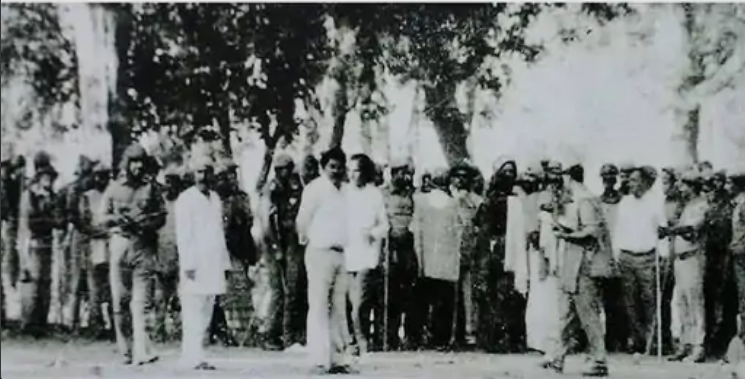
The Coolie Begar Movement began on January 13-14, 1921, on the occasion of the Uttarayan festival. The common people participated in this movement wholeheartedly.
People from different villages held a massive demonstration.
The movement began at the confluence of the Saryu and Gomti rivers. Before the movement began, the District Magistrate had served notices to Pandit Hargovind Pant, Chiranjilal, and Badri Dutt Pandey.
However, this had no effect on them. The crowd first went to the Bagnath temple to offer prayers. A procession of 40,000 people marched towards the Saryu Bagad.
At the forefront of the procession was a flag with the inscription: Stop the coolie forced labor.
Following this, a gathering was held at the Saryu Maidan. Addressing the gathering, Mr. Badri Dutt Pandey said, “Taking water from the holy Saryu and with the Bagnath Temple as witness, pledge that from today onwards, the practice of unpaid coolies will not be tolerated.”
Everyone took an oath to end this practice. The register was taken from the village head and torn up, marking the complete end of this practice.
At that time, the then Deputy Commissioner of Almora, Double, summoned Badri Dutt Pandey and said, “You have violated Section 144. Leave immediately, or you will be taken into custody.” Badri Dutt Pandey replied, “Now my dead body will be taken from here.”
Hearing this, the police officer became furious and threatened to fire on the crowd.
But due to the limited police force, he was unable to do anything. After this successful movement, the public bestowed the title of Kumaon Kesari on Badrinath Pandey.